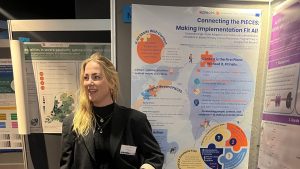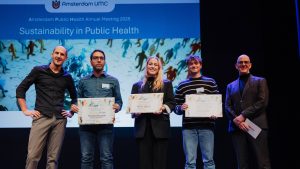
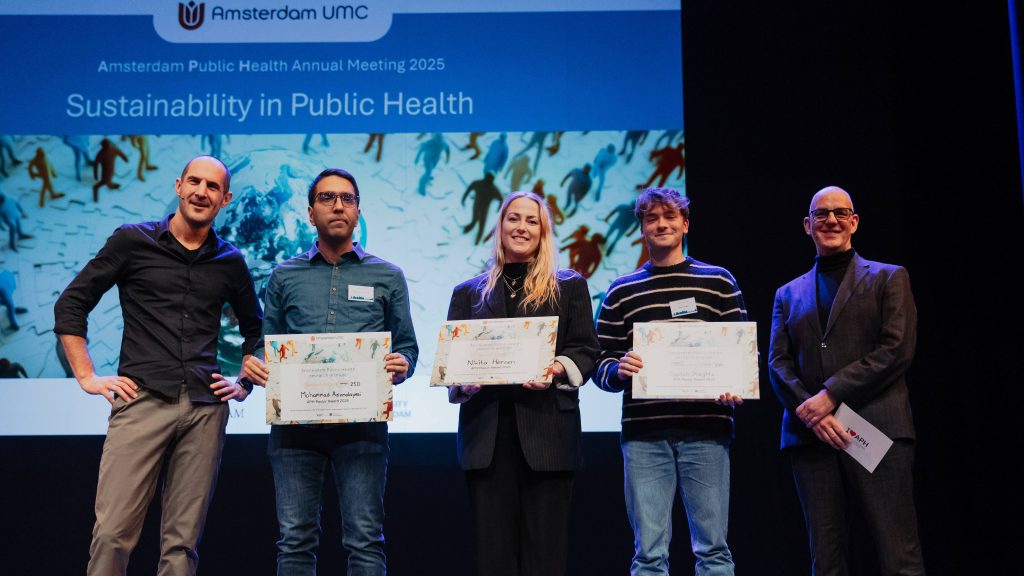
Nikita Hensen, PhD candidate at Amsterdam UMC and member of the PIECES consortium, was awarded the Poster Prize at the Amsterdam Public Health (APH) Annual Meeting 2025. This year’s meeting focused on sustainability in public health, showcasing efforts to develop health solutions that are robust, adaptable, and meaningful for diverse communities. The award recognises research that strengthens the connection between scientific evidence and societal needs—a core objective of the PIECES Project.
About the Awarded Poster
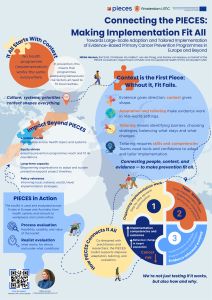
The prize-winning poster presented the foundations of the PIECES project, which aims to advance adaptation and tailored implementation in primary cancer prevention. Although many existing frameworks remain conceptual and offer limited guidance for practice, PIECES seeks to address this gap by developing a structured, theory- and evidence-informed implementation support toolkit.
The poster highlighted three key messages:
- Context matters: Implementation success depends on how well programmes align with local needs, resources, and constraints.
- Adaptation and tailoring are essential: Evidence-based approaches must be thoughtfully adjusted to maximise relevance, equity, and effectiveness.
- The PIECES Toolkit supports teams: The toolkit provides practical guidance and builds implementation competencies for real-world settings.
A central insight of the project is that implementation success depends less on selecting the “right” programme and more on tailoring it effectively to the local context.
Current Project Work
The PIECES Toolkit is currently being tested across 11 diverse sites in Europe and Australia. Using a combination of mixed-method process evaluation and realist evaluation, the project aims to identify not only whether the toolkit works, but also what works, for whom, and under what conditions—critical knowledge for scalable and sustainable implementation.
Significance of the Work
The PIECES Project seeks to provide a practical, scalable, and equity-focused approach to tailored implementation in cancer prevention. By supporting practitioners to adapt programmes systematically and confidently, PIECES contributes to prevention strategies that are more effective, context-responsive, and closely aligned with population needs.