
Consortium
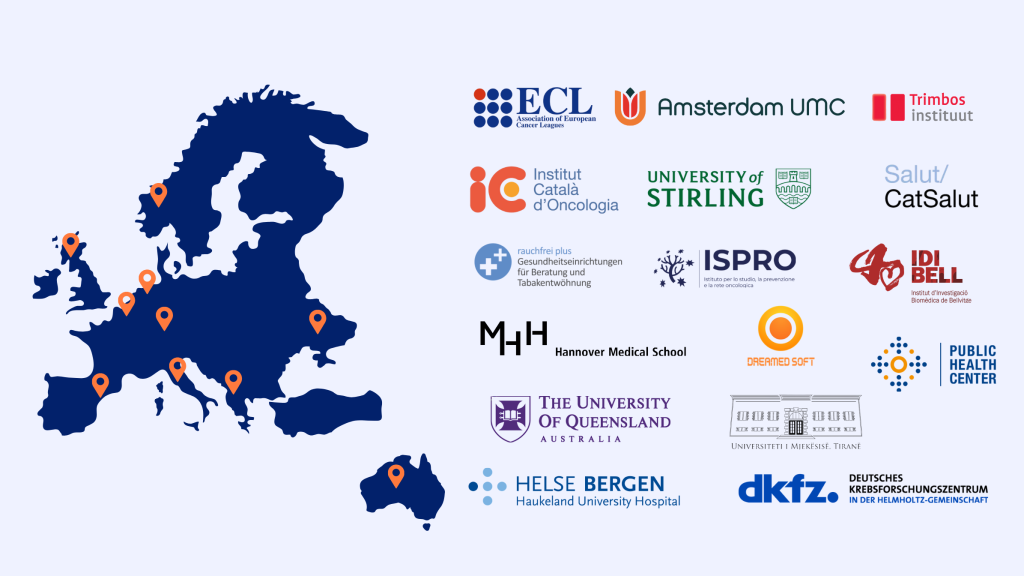
15 Partners
The PIECES consortium has been carefully composed to incorporate all the relevant expertise, experience, and capabilities needed to achieve our ambitious project goals. Formed by 15 partners, our consortium brings together a complementary range of disciplines, including public health, cancer epidemiology, technical expertise, a strong implementation science theoretical background, and access to real-life implementation settings.
The Catalan Institute of Oncology (ICO) is a public non-profit comprehensive cancer organisation with a high international recognition (i.e., WHO Collaborating Centre for Tobacco control and WHO HPV Information Centre). On top of cancer care and prevention, specialised training, and research, ICO develops primary cancer prevention and implementation research through its Cancer Prevention and Control Programme and Cancer Epidemiology Research Programme. ICO is partnering with both the Catalan Health Service (CatSalut), which is the unique purchaser of public services for all 7.7 million Catalonian citizens, and the Public Health Agency of Catalonia (ASPCAT), which is responsible amongst other tasks for Public Health policies and programmes for the Region. In PIECES, the close collaboration between the three entities will allow access to all the public healthcare network in Catalonia, comprised by 71 hospitals, 371 primary care centres, and 96 intermediate care centres.
The Catalan Health Service (CatSalut) is the entity that guarantees public health care to all citizens of Catalonia. It was born in 1991 as an entity for planning, evaluation and financing of services and benefits, within the fields of health and social health care.
In order to comply with its main objective of guaranteeing quality public coverage assistance to all citizens of Catalonia, it carries out the function of purchasing health services from the various provider entities, based on the health needs of the population it defines the Department of Health and also evaluates the satisfaction of citizens with the services provided.
Amsterdam University Medical Center’s mission is to promote healthy behaviours in their broad societal context and to prevent health conditions and reduce health inequalities – through high-quality and impactful research, education and dissemination. Amsterdam UMC focus primarily on: 1) the prevalence and causes of health behaviours (e.g. nutrition, physical activity, sports, sedentary behaviour, smoking) and their consequences for health and health inequalities, and 2) identifying, developing, implementing, and evaluating solutions to health behaviour problems to improve health and reduce health inequalities. Their research covers a wide range of topics, such as: food systems, lifestyle medicine, physical activity surveillance, sport injury prevention, and tobacco control.
Trimbos is an independent non-profit research and knowledge institute providing research, policy, and practice-based advice for policy makers and professionals on mental health and substance use across the life course. Trimbos has the Netherlands Expertise Centre for Tobacco control (NET) and the Expertise Centre on Alcohol (EA) to support professionals and implement evidence-based interventions for reducing tobacco and alcohol consumption, with potential reach to all 17,7 million inhabitants of the Netherlands. Trimbos collaborates closely with several partner organizations, including the National Institute for Public Health and the Environment (specifically, the WHO Collaborating Centre for Tobacco Product Regulation and Control), the Netherlands Network for Tobacco Researchers, the Partnership Stop Smoking, and national health charities that are active in cancer prevention, such as the Cancer Society, Hearth Foundation and Lung Foundation. In collaboration with Santé publique France, Trimbos chairs a EuroHealthNet thematic working group on Social Marketing to Address Addictions, focussing on tobacco and alcohol prevention.
The University of MedicineTirana (UMT) is a public non-profit university and the biggest Albanian research centre covering all medical and life-sciences, including areas of disease prevention and health promotion, with close links with the Institute of Public Health (IPH), a public non-profit research and university centre that operates as technical branch of Ministry of Health; both led the recently approved 2022-2030 National Cancer Control Plan. IPH provides technical guidance to 36 local Units of Health Care in all districts of the country, while coordinating national cancer registry and other programme databases. UMT and IPH partner with the newly established national agency for management of health care (National Health Care Operator), running all healthcare institutions including 413 primary health care centres and 12 regional hospitals; reaching this way virtually 2.8 million inhabitants for education, prevention and research purposes.
The “Istituto per lo studio, la prevenzione e la rete oncologica” (ISPRO) is a public Research Institute belonging to the National Health System of Italy and Tuscany Region (3.7 million people), endowed with public legal personality and organizational, administrative, and accounting autonomy. ISPRO main aim is to promote and study primary, secondary and tertiary cancer prevention interventions and to organize and coordinate pathways of research programmes, diagnosis, treatment, and rehabilitation in oncology, in collaboration with hospitals and local health units. ISPRO activities include epidemiological evaluation and surveillance, management of registries, design, implementation and monitoring of screening programmes, and coordination of the Tuscany cancer network for the definition and monitoring of clinical guidelines, and oncological diagnostic and therapeutic pathways.
The Association of European Cancer Leagues (ECL) is a non-profit, pan-European umbrella organisation of national and regional cancer societies. Located in Brussels, ECL provides an exclusive platform for members to collaborate with their international peers, primarily in the areas of cancer prevention, tobacco control, access to medicines and patient support, and creates opportunities to advocate for these issues at the EU level. ECL’s VISION: A Europe free of cancers ECL’s MISSION: To advocate for improved cancer control and care in Europe through facilitating collaboration between cancer leagues , and influencing EU and pan-European policies.
Hannover Medical School (MHH) is represented by an interdisciplinary team of physicians, sports scientists, oncologists and nutritionists in an institutional collaboration between the Institute of Sports Medicine, Department of Rehabilitation- and Sports Medicine (led by Prof. Dr. Uwe Tegtbur) and the Department of Gastroenterology, Hepatology, Infectious Diseases and Endocrinology (led by Prof. Dr. Heiner Wedemeyer). Hannover Medical School is an oncological center of excellence with certifications by the German Cancer Society and part of the Comprehensive Cancer Center Lower Saxony (CCC-N). Our background brings together the expertise of a visceral oncology center with the knowledge about the establishment of individually tailored sport programs based on personal needs and risks. As an implementation site for physical activity, we aim to use the PIECES Toolkit to implement a physical activity program for people with metabolic risk factors and liver diseases to enhance individual health and reduce cancer risk. Our implementation setting is the occupational health care system with internal health check-ups via the medical service in a large automotive company.
Public Health Centre of Ukraine (UPHC) is responsible for controlling the sanitary and epidemic situation in the country, prevent diseases, fight against epidemics, increase life expectancy, and improve the health of citizens. In the frame of health care reform in Ukraine the focus has been shifted to health promotion and diseases prevention. Besides designing public health campaigns, UPHC conducts epidemiological research, mainly through its department of Behavioural Risk Factors. This department investigates the prevalence of cancer risk factors addressed in PIECES, including tobacco and alcohol consumption, low physical activity, and an unbalanced diet. Ukraine is currently deploying regional disease control and prevention centres aimed at delivering campaigns for the prevention of non-communicable diseases covering all country regions. Therefore, interventions implemented in the context of the PIECES project are expected to benefit the entire 35 million population.
Haukeland University Hospital is the second largest university hospital in Norway, known for its extensive investment in medical and health-related research and innovation. The primary aim of research and innovation at Haukeland University Hospital (HUH) is to enhance health services and provide effective, high-quality healthcare in a secure way. Forhelse SFI (Centre for Digital Healthcare) is a research-based innovation project led by Haukeland University Hospital. Funded by The Research Council of Norway, Forhelse encompasses multi-year research and innovation projects that involve close collaboration with national and international partners in academia, industry, health services, and user organizations. This initiative focuses on advancing healthcare solutions to improve accessibility and quality of care.
The German Cancer Research Center (Deutsches Krebsforschungszentrum, DKFZ) is a public, non-profit comprehensive research centre and the largest biomedical research institute in Germany. Its Unit Cancer Prevention (UCP) is devoted to implementing evidence-based programmes in tobacco, alcohol, and HPV prevention. Currently, the DKFZ is setting up, in collaboration with the German Cancer Aid, the National Cancer Prevention Centre, which will combine high-level prevention research, education and training, as well as public relations and policy advice and implement them nationwide via outreach programs and networking.
The University of Stirling is an international university with pioneering spirit and a global reputation for high-quality teaching and research. Founded in 1967, the University of Stirling has always been driven by transformative thinking and a will of innovation. Its aim is to be recognised across the world as a University that addresses the needs of society through innovative and interdisciplinary research, learning and teaching of the highest quality, and by sharing its knowledge with the world. The core strength of the University of Stirling is the people. To build on our success, they invest in the best staff from around the world to deliver on the ambitious strategies for research, teaching and international partnerships. The Institute for Social Marketing (ISM) is the UK’s leading social marketing research centre, bringing over 35 years’ experience to the study and dissemination of social marketing theory and practice. ISM conducts research in three areas: the use of social marketing concepts and theory to understand health behaviour and to inform the development and evaluation of behaviour change interventions; the critical examination of the effects of commercial marketing on health and society, and the impact of policies to control commercial marketing and to protect public health.
The German Network for Tobacco Free Healthcare Services (Deutsches Netz Rauchfreier Krankenhäuser und Gesundheitseinrichtungen e.V., DNRfK) supports implementation of tobacco control standards in healthcare services. With “smoke-free plus”, members of the network integrate tobacco cessation in treatment processes and denormalize tobacco consumption on their premises. Implementation is based on a self-audit tool and step-by-step change process coordinated by an implementation team and supported by exchange of best practice and a peer review. Implementation of systematic screening, brief intervention and referral to the Quitline with the “smoke-free ticket” is funded by the German Federal Centre for Health Education and lead by the DNRfK team. To support nurse’s role in tobacco control and network of nursing schools is established. Nursing teachers get trained to implement a program to reduce tobacco use among nursing students and to integrate training in brief interventions as a standard part of nursing education. The network is seen as a nationally valuable platform for the development of further tobacco-control programs in health care and received the WHO World No Tobacco Day Award 2021.
With two research intensive schools, medical education, and five hospital-based institutes and centres, we are well positioned to link the pre-clinical and clinical sciences with population and global health. Within our Faculty, we are teachers and we are researchers. We are students and we are staff. We are health professionals and together, we are united in our quest to make a global difference to health outcomes. Medical and biomedical science research projects within the Faculty have already led to discoveries with far-reaching social and economic impacts, including the Gardasil vaccine for cervical cancer.
Dreamsoft Solution is a rapidly growing IT company with extensive experience in designing and developing cutting-edge custom software solutions. We are a team of highly motivated IT professionals with a strong ability to innovate and an unwavering commitment to excellence.
Advisory Board & Ethics Advisor
By means of the external Advisory Board (AB), PIECES seeks regular external advice on relevant issues. The AB provides expert guidance on the quality of project deliverables to ensure that work develops in accordance with appropriate legal, ethical, and social standards, as well as the general philosophy and direction of the project. It also advises on corrective measures regarding the content of the work if necessary, and guides the dissemination and exploitation of the project’s results.
Dr. David Chambers
Dr. David Chambers is Deputy Director for Implementation Science in the Office of the Director in the Division of Cancer Control and Population Sciences (DCCPS) at the National Cancer Institute (NCI). Dr. Chambers manages a team focusing on efforts to build and advance the field of Implementation Science (IS) through funding opportunities, training programs, research activities, dissemination platforms, and enhancement of partnerships and networks to integrate research, practice and policy. Prior to his arrival at NIH, Dr. Chambers worked as a member of a research team at Oxford University, where he studied national efforts to implement evidence-based practice within healthcare systems. He publishes on strategic directions in implementation science and serves as a plenary speaker at numerous scientific conferences.

Prof. Maria E. Fernández
Dr. María Fernández is Vice President of Population Health and Implementation Science at the University of Texas Health Science Center at Houston (UTHealth Houston) and the founding Co-Director of the UTHealth Houston Institute for Implementation Science. Dr. Fernández is also the Lorne Bain Chair of Public Health and Medicine, Professor of Health Promotion and Behavioral Sciences, and Director of the Center for Health Promotion and Prevention Research (CHPPR) at the UTHealth Houston School of Public Health. Dr. Fernández has spent her career leading participatory community-engaged intervention and implementation research to develop, evaluate, implement, and disseminate interventions to improve health and health equity. Her research focuses on chronic disease prevention and control among underserved populations in the U.S. and globally. Dr. Fernández has over 235 peer-reviewed publications and has co-authored several books, including the 4th edition of Planning Health Promotion Programs: An Intervention Mapping Approach (2016) and the Handbook of Community-based Participatory Research (2017). Her awards include the Association for Schools and Programs of Public Health Research Excellence Award and the UTHealth President’s Scholar Award for Research Excellence.

Prof. Jose M. Martin-Moreno
With medical and public health degrees from the Univ. of Granada (MD, PhD) and Harvard (MPH, DrPH), he served as the former Director of Program Management for Europe at the World Health Organization, and previously as Chief Medical Officer of Spain. Currently, he holds a professorship in Preventive Medicine and Public Health at the Medical School and Clinical Hospital of the Univ. of Valencia. He is also a Member of the Royal Academy of Medicine of Spain, an Honorary Member of the Faculty of Public Health of the Royal College of Physicians of the United Kingdom, a Policy Adviser for the European Observatory on Health Systems and Policies, and the Director of the European Summer School of Public Health “Andrija Stampar”. Moreover, he serves as Co-Chair of the “Sciana: The World Health Leaders Network” and is a member of the Advisory Board of the Spanish Society of Health Managers. He has authored over 400 scientific articles and has been awarded at the European Health Public Conference the Stampar Medal for excellence in Public Health.

Dr. Leti van Bodegom-Vos
Leti van Bodegom-Vos, PhD, is senior researcher at the Leiden University Medical Center in the Netherlands. She completed her study in health sciences in 2004 and obtained her PhD from Maastricht University in 2010. She was appointed as implementation fellow of the Dutch Organisation for knowledge and innovation in health, healthcare and well-being. Her research focuses on the implementation of high-value care and the de-implementation of low-value care in the hospital setting.
Prof. Signe Flottorp
Signe Flottorp (born 1954, MD 1979) is trained as a general practitioner. She has worked with health services research since 1994, focusing on ways to support informed health choices through systematic reviews, effective dissemination of research findings, knowledge translation and implementation research. She is an associate editor of Implementation Science, and she was an associate editor of the Cochrane Effective Practice and Organisation of Care (EPOC) review group. She has participated in the GRADE working group since the start in 2000, contributing to the GRADE approach to assess certainty of evidence and strength of recommendations, and she has been a member of the GRADE guidance group. She was chair of the Board of Health and Care Services Research in The Research Council of Norway 2008-2015. She has recently retired from her full-time position as a Research Director at the Centre for Epidemic Intervention Research at the Norwegian Institute of Public Health, where she now works part time.

Dr. Harriet Koorts
Associate Professor Harriet Koorts is an Implementation Scientist with a background in public health and academia spanning over 15 years. Their research focuses on the implementation and scale-up of population health interventions, into clinical and community settings, using implementation and systems science methodologies. A/Prof Koorts leads Deakin University’s Institute for Physical Activity and Nutrition (IPAN) Implementation Science and Knowledge Translation Domain, and co-leads Deakin’s Faculty of Health Knowledge Translation and Evaluation Unit. Within these roles, they provide implementation science consultancy to >90 IPAN staff, across the Faculty and externally as required.

Andrea Buron
Andrea Buron is a medical doctor and specialist in preventive medicine and public health. She works as an epidemiologist in the Epidemiology and Evaluation Department of Hospital del Mar (Barcelona), in the area of breast and colorectal cancer screening. Andrea is lecturer in public health ethics at Universitat Pompeu Fabra and University of Manresa (both at Master level). Although she has a general training in ethics (Oxford University), her expertise in ethics lies specifically within the specific area of public health ethics, which unlike bioethics, focuses more on the interventions at the population level instead of the individual level.She is member of the Ethics working group of both EUPHA and SESPAS, and has also participated in several ethics working groups, seminars, workshops, articles, and committees.